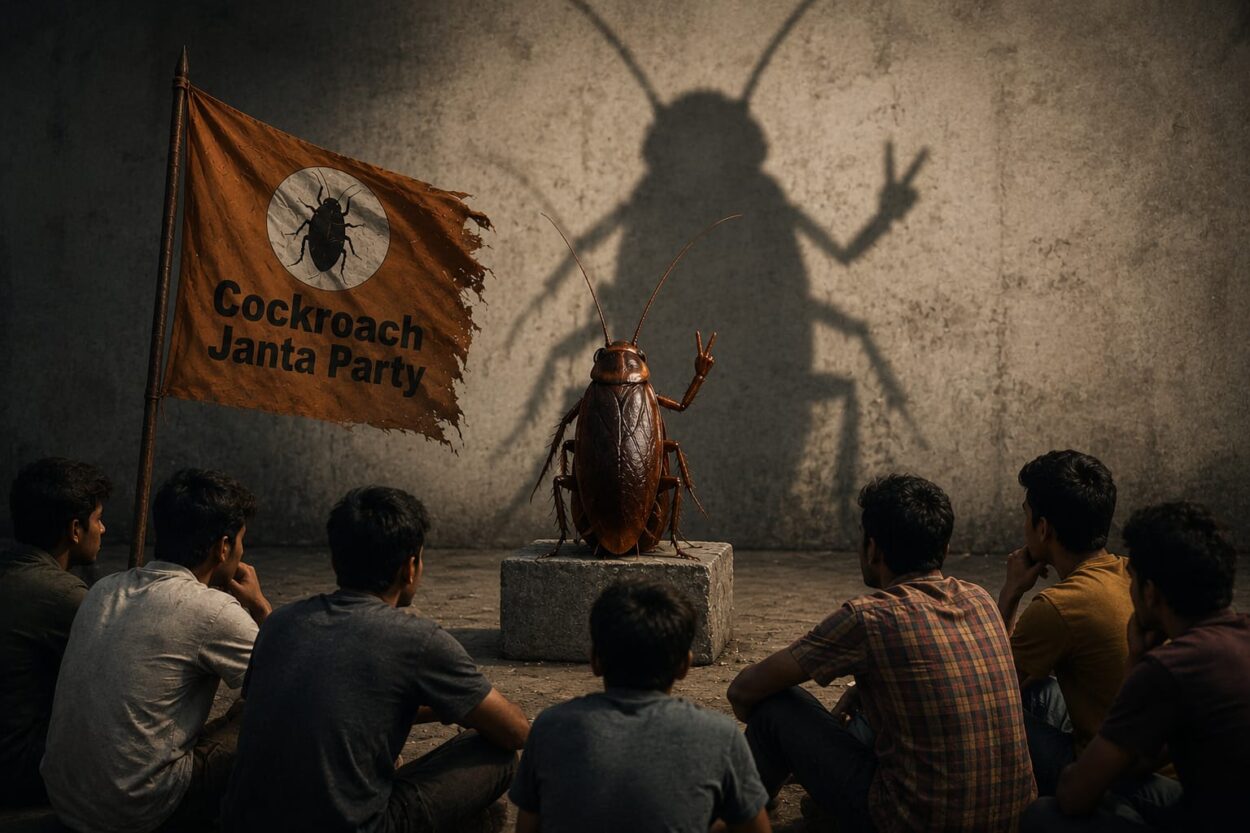
Nowadays, it is typically believed that stable democracies can effortlessly digest online satire. However, the sudden and powerful emergence as well as the harsh governmental termination of India’s “Cockroach Janta Party” (CJP) unexpectedly disproves this belief.
The CJP, a satirical group, originated from a controversial judicial comment which compared certain young people to “cockroaches.” This movement paradoxically insisted their members be “lazy and unemployed,” yet they quickly gathered millions of supporters, surpassing even the most digitally prominent political parties. Such a case leads one to critically and impartially wonder: What made a mere digital jest trigger a heavy-handed government crackdown at the level of national security? And, what does this incident tell us about the maturity of both the power-holding and the protesting youth elements?
The State’s Reflex: A Democracy of Silence
After the CJP reached one million website registrations and collected hundreds of thousands of petitions over the tragic NEET exam leaks, the government chose not to respond; instead, it enacted a total digital blackout. The CJP’s website was blocked, its X (formerly Twitter) account was suspended, and its huge Instagram page was hacked.
State authorities defended this by labeling the movement as a threatening “influence operation,” claiming that 49% of the followers were Pakistani bots designed to destabilize the country. Even though defending the country’s sovereignty from psychological warfare operations is a valid task of the state, employing it as a carte blanche justification to wipe out natural youth dissent highlights deeply rooted institutional fear.
The establishment is scared because Gen Z has figured out how to digitally dismantle the exact playbook that the ruling elite used to evade traditional media and gain power in 2014. Just shutting down websites does not signal state power; it signals a weak “democracy of silence,” where asking questions of the system leads to immediate elimination.
The Illusion of Viral Activism
However, it is not enough to just shout on the internet to break from this “democracy of silence”. This also happens to be the very reason the CJP exposes its significant tactical flaws, according to astute political observers.
The biggest deception of modern activism, they point out, is to equate viral measurements with a genuine revolution. It is an exercise in futility to ask for cabinet resignations, such as that of the Education Minister, from a political class that has never responded to public pressure before. Having a huge Instagram following is politically worthless if the followers keep staring at their screens.
From Servers to the Streets
To really shake the system and extend their impact beyond just a one-day internet sensation, the CJP should give up the dream of instant institutional reforms and accept the harsh facts of grassroots politics. Youngsters will have to move from merely showing off on the internet to posing undeniable, very locally focused questions such as holding local authorities accountable for fundamental civic rights, like the absence of ambulances at traffic stops.
Moreover, working solely in digital siloes is the surest way of getting wiped out. In order to stay alive, these decentralized networks need to enter into strategic partnerships with wider democratic forces based on a “Common Minimum Program.” More importantly, the revolt has to start locally: opposing the WhatsApp-driven propaganda that their parents are being fed and nurturing the challenging yet necessary democratic discussions in their living rooms.
The Cockroach Janta Party symbolizes in the most extreme way a system that is failing its youth—a whole generation going through the hardship of unemployment, resorting to memeification as its only way of coping.
Indeed, this series of events is a wake-up call for both the government and the youth. The government should come to understand that no amount of digital censorship can erase the sincere economic hardships of millions of graduates. At the same time, the youth need to realize that they cannot simply “hack” a complicated political system as easily as an Instagram page. Unless they take their struggle from the servers to the streets, they may end up solidifying the very reality they are mocking i.e., being politically forced to survive in the shadows as the very insects they have taken their name from.